Empowering the Workforce: How Accessible Tools Transform Disability Employment in Asia

The economic landscape of Southeast Asia is experiencing a period of unprecedented transformation. Digitalization, the rapid reconfiguration of global value chains (GVCs), and the transition toward green economies are reshaping the future of work across the ASEAN region. Yet, amidst this massive economic acceleration, one critical demographic remains systemically sidelined: persons with disabilities (PWDs).
The data reveals a stark, uncomfortable reality. According to recent comprehensive studies by the International Labour Organization (ILO), the labor force participation rate for persons with disabilities in the Asia-Pacific region stands at a mere 25.4%. In sharp contrast, the participation rate for persons without disabilities is 60.4%. The gap widens even further when examining the intersection of gender, with women with disabilities facing a participation rate of just 15.4%.

This systemic exclusion is not just a human rights failure; it is a massive economic misstep. Keeping millions of capable individuals out of the workforce traps families in cycles of poverty and deprives modern industries of a highly resilient, adaptive talent pool.
While policy reforms, hiring quotas, and corporate diversity training are essential, they frequently fail to address the most immediate, physical barrier to entry: a lack of access to context-appropriate Assistive Technology (AT).
The Physical Bottleneck in the Modern Workplace
When corporate leaders discuss unemployment among individuals with disabilities, the conversation often defaults to societal stigma or discriminatory hiring practices. While attitudinal barriers are a massive hurdle, the immediate blockade is often purely logistical.
For an individual living with an upper limb amputation or severe mobility restriction, navigating a standard workplace presents an array of physical friction points. Operating a standard computer keyboard, managing physical documents, utilizing specialized industry tools, or even independently managing personal hygiene during a workday can be insurmountable without the correct physical support.
The United Nations Convention on the Rights of Persons with Disabilities (CRPD), which serves as the international baseline for inclusion, explicitly outlines these rights. Article 20 mandates the right to personal mobility with the greatest possible independence, while Article 27 emphasizes the right to work on an equal basis with others.
However, rights articulated on paper mean little without the physical tools required to exercise them. The World Health Organization (WHO) estimates that over 2.5 billion people globally require assistive products. Tragically, in low- and middle-income countries (LMICs) across Asia, access rates to these vital tools plummet to a dismal 5% to 10%. Traditional, imported assistive devices, such as complex myoelectric prosthetics, are frequently prohibitively expensive, prone to breaking in harsh climates, and incredibly difficult to repair locally.
The Economic Multiplier Effect of Assistive Technology
Providing an individual with an appropriate assistive device does not just solve a physical problem; it generates an immediate economic multiplier effect. Studies highlighted by ATscale and the ILO indicate that providing access to fundamental functional aids can increase a user’s lifetime earning potential by an average of $100,000 USD.
When workers have the tools to manage their own mobility and daily tasks, reliance on unpaid family caregivers decreases, freeing up entire households to participate more fully in the economy. Furthermore, appropriate AT directly increases workplace productivity and drastically reduces absenteeism.
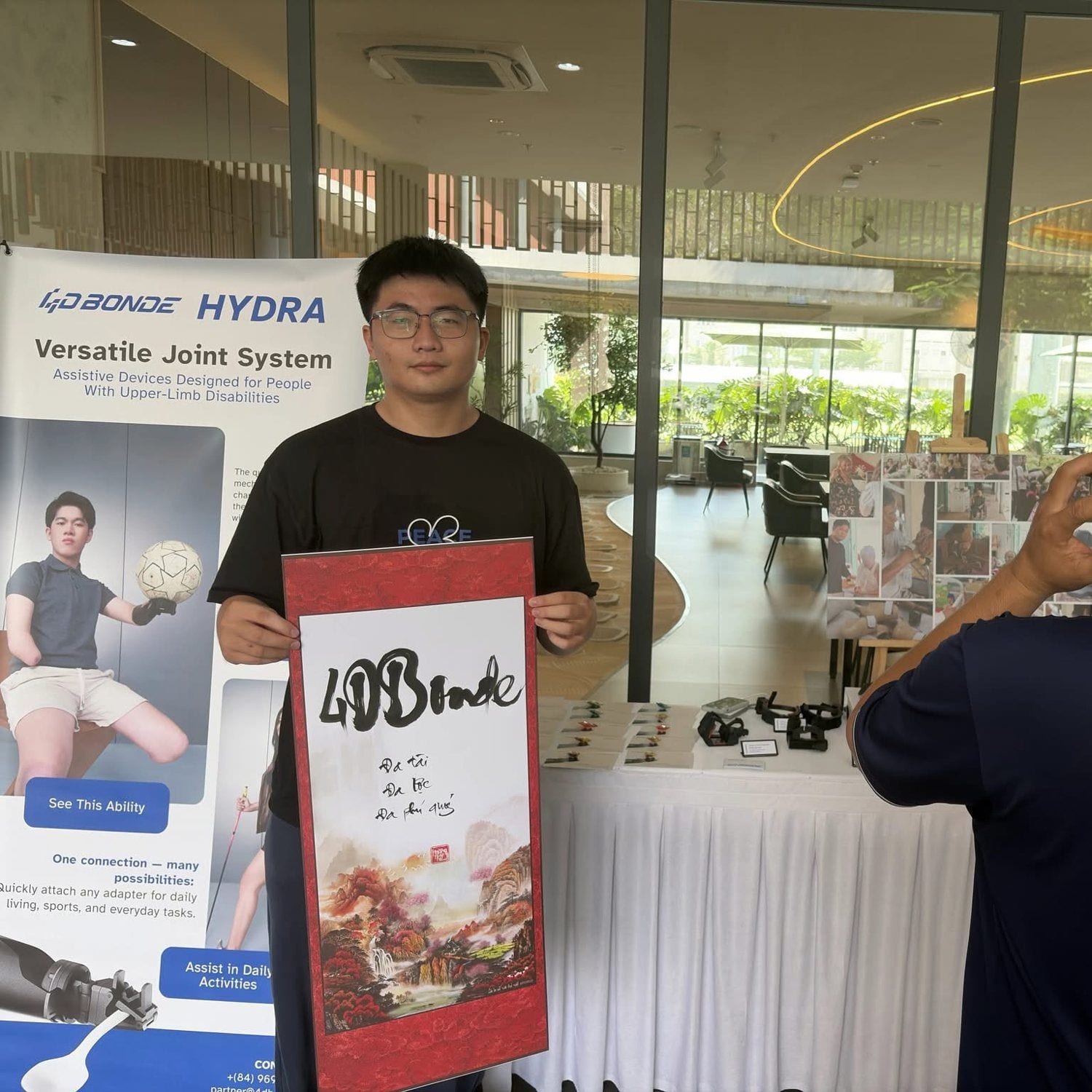
This is the precise economic bottleneck that Vietnamese social enterprise 4D - BONDE is actively dismantling. By designing, manufacturing, and deploying the Multi-Purpose Joint Set (Bộ Khớp Đa Năng) domestically, the enterprise is breaking down the financial and logistical barriers that keep individuals with upper limb differences out of the labor market.
The impact of this modular technology in a professional setting is transformative:
- Access to the Digital Economy: The modern workforce is inherently digital. 4D - BONDE has engineered specific tool heads that allow users to interface seamlessly with keyboards and touchscreens. This directly enables users to secure roles in IT, administration, digital marketing, and the burgeoning tech sectors across ASEAN.
- Physical Task Adaptability: For roles requiring manual interaction, from hospitality to light manufacturing, the modular nature of the device allows workers to swap out tool heads for different, reliable grips, ensuring they can perform physical tasks safely and efficiently.
- Professional Autonomy and Confidence: Perhaps the most vital metric is independence. When a worker can independently manage their commute, consume meals in the corporate cafeteria, and organize their workspace without relying on a colleague or caregiver, their professional confidence skyrockets.

This reality is vividly captured in 4D - BONDE's recent "See This Ability" campaign. The initiative highlights real-world users thriving in their respective fields, including an IT professional writing code and a digital content creator managing media. These individuals explicitly demonstrate that intellectual and professional capability is rarely the issue; gaining access to the right physical tools is the true threshold.
Building Inclusive Corporate Ecosystems
Governments and multinational corporations are increasingly recognizing that disability inclusion is not merely a philanthropic endeavor; it is a strategic economic imperative. Integrating workers with disabilities fosters workplace innovation, enhances corporate culture, and taps into a fiercely loyal segment of the labor market.
However, human resource departments cannot achieve true inclusion in a vacuum. Businesses must move beyond simply establishing hiring quotas and actively partner with assistive technology providers to ensure their work environments are accessible by default. By supporting and procuring from domestic social enterprises like 4D - BONDE, organizations can help build a robust, localized supply chain for assistive devices. This ensures that employees have continuous access to maintenance, upgrades, and customized tools without waiting months for overseas shipping.
The path to a fully inclusive, high-performing Southeast Asian economy is complex, but the foundational step is remarkably clear. By investing in affordable, user-centric assistive technology, we stop asking how individuals with disabilities can adapt to the workplace, and start equipping them with the tools to redefine it.
The disability employment gap in Southeast Asia, and how affordable assistive technology like 4D - BONDE's modular systems supports inclusive workplaces.